How to Correctly Fill Out Identifying Marks for Your NBI Clearance Application
Applying for an NBI Clearance in the Philippines is a rite of passage for most job seekers and professionals. While the process has moved largely online, one section of the form still causes a bit of a “brain freeze” for many applicants is Identifying Marks.
If you’ve ever stared at that blank box wondering if your tiny mole counts or if you should mention that childhood bike accident scar, this guide is for you. Let’s discuss everything you need to know to fill out this section accurately and speed up your clearance process.
What Counts as an Identifying Mark?
In the context of the National Bureau of Investigation, an identifying mark is any permanent, visible physical feature that distinguishes you from someone else , especially from someone who might share your exact name.
Think of it as a secondary layer of identity verification. While names can be identical and fingerprints can occasionally be blurred, a specific tattoo on a specific wrist or a distinct birthmark on the neck provides a unique “physical fingerprint.”
Common Categories of Marks
- Natural Features: Moles (nunal), birthmarks, or permanent dimples.
- Accidental Scars: Marks left behind by old injuries, stitches, or burns (peklat).
- Surgical Marks: Scars resulting from operations like an appendectomy or a C-section.
- Body Art: Professional or amateur tattoos and visible piercings.
Why the NBI Cares About Your Scars and Moles
You might wonder why the government needs to know about a mole on your cheek. The primary reason is the “HIT” system.
In the Philippines, many people share the same first and last names. If a person with your name has a criminal record, your application will result in a “HIT.” To clear your name and prove you aren’t the individual in the NBI database, the bureau looks at biometrics and physical descriptions. If the “person of interest” has a scar on their forehead and you don’t, it becomes much easier for the NBI to verify your innocence and issue your clearance.
How to Find Mark on Your Body – Check List
Before you log into the NBI portal or head to the satellite office, take five minutes to do a “self-audit.”
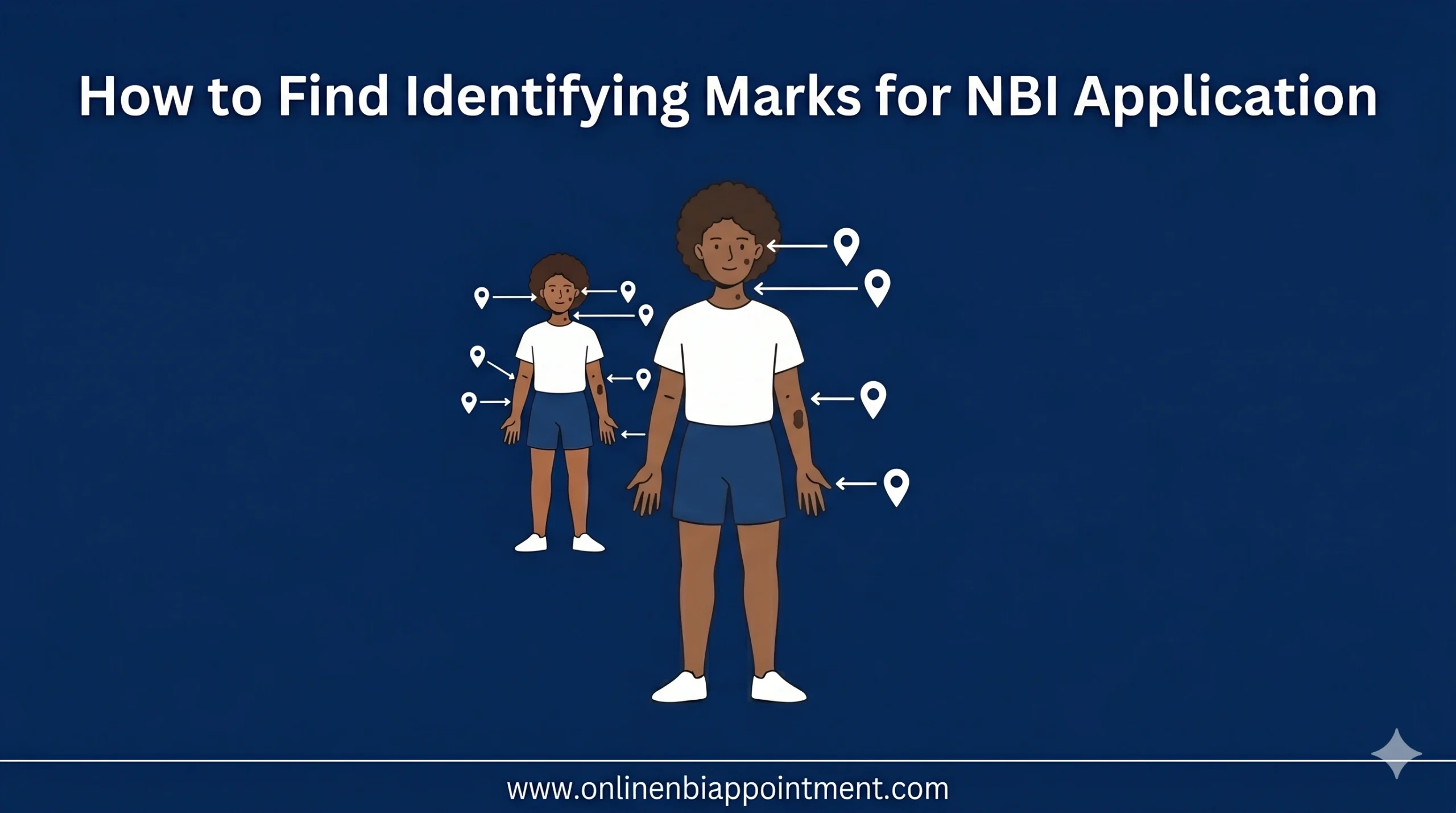
- Check Visible Areas First: Focus on your face, neck, arms, and hands. These are the most common areas checked.
- Use a Mirror: Don’t forget the back of your neck or your shoulders.
- Be Specific but Concise: You don’t need to write a paragraph. “Small mole on right chin” is better than just “Mole.”
- The “None” Option: If your skin is perfectly clear of any notable marks, it is perfectly acceptable to write “NONE” or “N/A.”
English vs. Tagalog – Which Should You Use?
The NBI is flexible. You can use English, Tagalog, or a mix of both, as long as the description is easy to understand. Here is a quick translation guide for your convenience:
| English Term | Tagalog Equivalent |
| Mole | Nunal |
| Scar | Peklat |
| Birthmark | Balat |
| Left | Kaliwa |
| Right | Kanan |
| Arm | Braso |
| Face/Cheek | Mukha / Pisngi |
Useful Tips to Write Description
To make the job easier for the NBI encoders, follow these simple formatting tips:
- Mention the Side: Always specify if the mark is on the left or right side of your body.
- Locate Exactly: Instead of saying “Scar on leg,” try “Surgical scar on right knee.”
- Identify the Type: Is it a tattoo? A burn? A birthmark? Label it clearly.
Good Example: “Mole on left upper lip, Heart tattoo on right forearm.”
Vague Example: “Tattoo and some scars.”
Identifying Marks vs. Complexion
Many applicants confuse their skin tone with identifying marks. Here is how they differ:
- Complexion: This refers to your overall skin color (e.g., Fair, Brown/Moreno, Dark, or Yellowish). This is a general category.
- Identifying Marks: These are specific “spots” or “irregularities” on that skin.
You will likely be asked for both on the form, so ensure you don’t put “Fair” in the identifying marks box!
Conclusion
The “Identifying Marks” section isn’t there to judge your appearance; it’s a security tool designed to protect your identity. By providing clear, honest, and specific details, you reduce the chances of misidentification and help the NBI maintain a more secure database.
Next time you renew your clearance, you’ll know exactly what to look for. Just keep it simple, keep it accurate, and you’ll be through the process in no time.